1.3 ALIGNMENT WITH THE WORLD BANK GUIDELINES FOR THE SUCCESSFUL REGIONAL INTEGRATION OF FINANCIAL INFRASTRUCTURES
The World Bank guidelines for the successful regional integration of financial infrastructures cover the following high level components;
- Enabling and Institutional Guidelines
- Planning Guidelines
- Design Guidelines
- Implementation Guidelines
- Sustainability Guidelines
TABLE OF CONTENTS
1.3.1 ENABLING AND INSTITUTIONAL GUIDELINES
1.3.2 PLANNING GUIDELINES
1.3.3 DESIGN GUIDELINES
1.3.4 IMPLEMENTATION GUIDELINES
1.3.5 SUSTAINABILITY GUIDELINES
1.3.1 ENABLING AND INSTITUTIONAL GUIDELINES
The purpose of the first set of guidelines is to outline the institutional arrangements that are necessary to enable a regional FI integration proposal to move forward in an effective fashion from its preliminary vision to an actual operating regional arrangement.
The work undertaken in the SADC Region has been framed under the SADC Finance and Investment Protocol (FIP) signed by the heads of state in SADC.
Regional payments initiatives were devolved down to the SADC Committee of Central Bank Governors (CCBG) and one of the most important arrangements made was the implementation of a memorandum of understanding (MOU) between the CCBG and the SADC Banking Association. This set out the roles and responsibilities of the public and private sector in any SADC payment development.
The diagram below depicts the SADC Payments Organizational arrangements
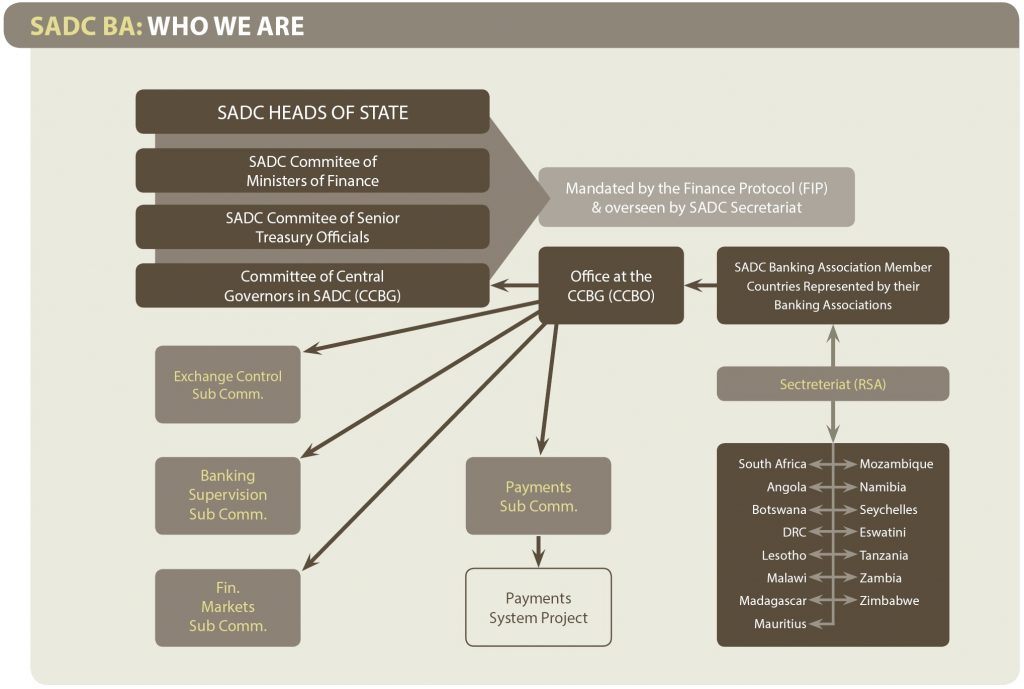
Diagram 1
1.3.2 PLANNING GUIDELINES
The World Bank guidelines state that the governance and planning framework for a project should underpin the cooperative and consultative arrangements and processes that were already established for the preliminary and exploratory discussions and consultations. The guidelines further state that it is crucial that all relevant stakeholder groups remain involved as needed throughout the project life cycle.
At the outset the SADC CCBG arranged for a central bank payments committee to drive the various SADC payment initiatives and in terms of the MOU with the SADC Banking Association the necessary planning framework was jointly instituted.
The CCBG Payments Committee mapped out a road map for development and prospective implementation dates.
The diagram below outlines the original SADC Payments Roadmap.

Diagram 2
Clear lines of responsibility and areas of cooperation between the CCBG Payments Committee and SADC BA were articulated at the commencement of the SADC Payments project. The diagram below explains the two main areas of responsibility between the public sector (CCBG) and the private sector (SADCBA).
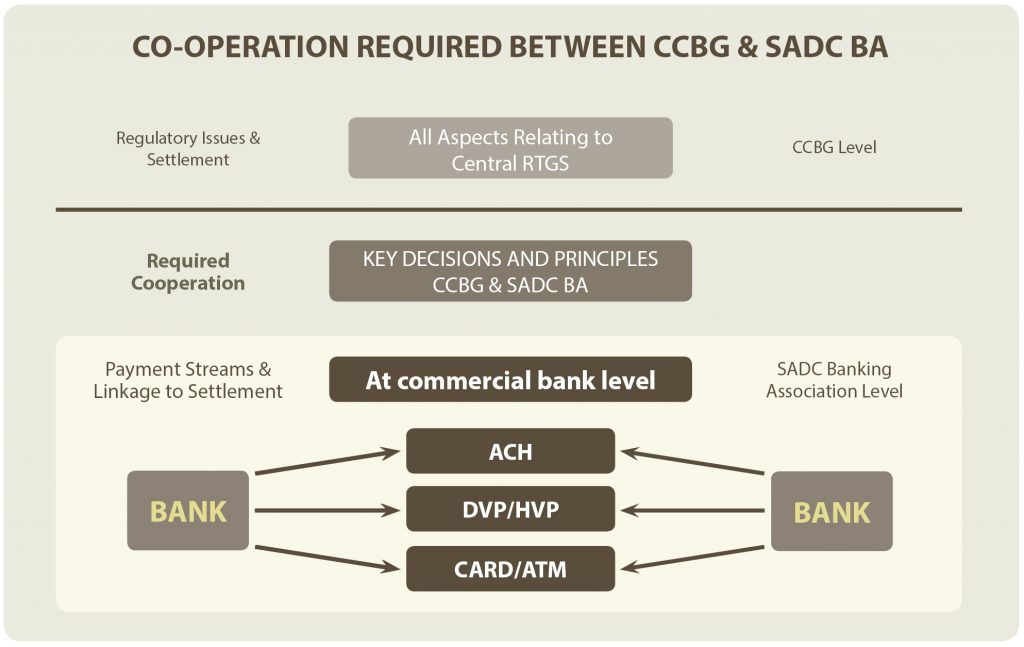
Diagram 3
It was agreed that the CCBG Payments Team would focus on all matters regulatory and inter-bank settlement and SADC BA would focus on all matters concerning the design, rules etc. concerning the commercial bank processing etc.
1.3.3 DESIGN GUIDELINES
The World Bank guidelines indicate that achieving the necessary buy-in for an integration model can also be impaired when the model is too narrowly described in terms of detailed technical aspects or other specific operating features. Making efforts to agree on all such particular features may conceal from decision-makers’ sight the project’s broader and long lasting benefits. Hence , it is highly beneficial that the integration model is outlined as comprehensively as possible, including among other broad elements;
- the structural architecture, including linkages and interoperability with other FI’s and the role and functions of key service providers;
- the operating schemes (rules, protocols, procedures and technical standards based in international standards and best practices;
- the technical design and operating systems based on internationally accepted operational and technical standards;
- any additional legal and /or regulatory developments that are needed; and
- how the model might facilitate transaction uptake once the new arrangement is launched.
The teams from the SADC Central Bank Payment Committee and SADC Banking Association first articulated the key foundation principles on which developments would be based. These are outlined in the diagram below.
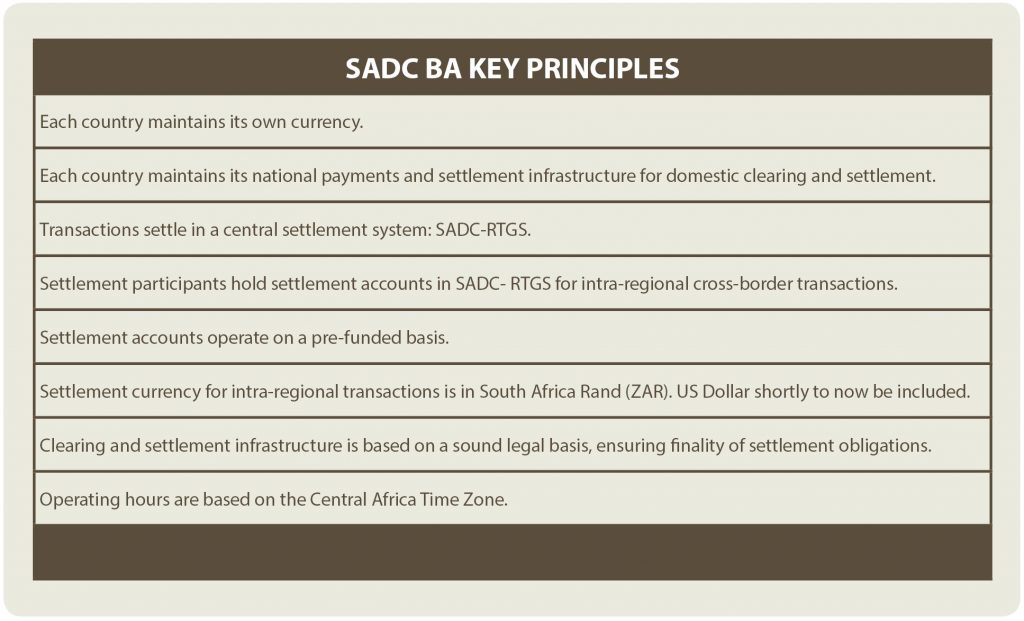
Diagram 4
The next major step in model design was the articulation of clear development boundaries. It was made clear from the start that the focus of development would be on the regional cross-border payment processing area and only in the inter-bank cooperative space.
Where is has been necessary to harmonize any aspect to support appropriate intra-country payment processing in the SADC region separate work streams were set up to tackle these specific tasks. Apart from this domestic regulation and in-country payment processing was kept out of scope.
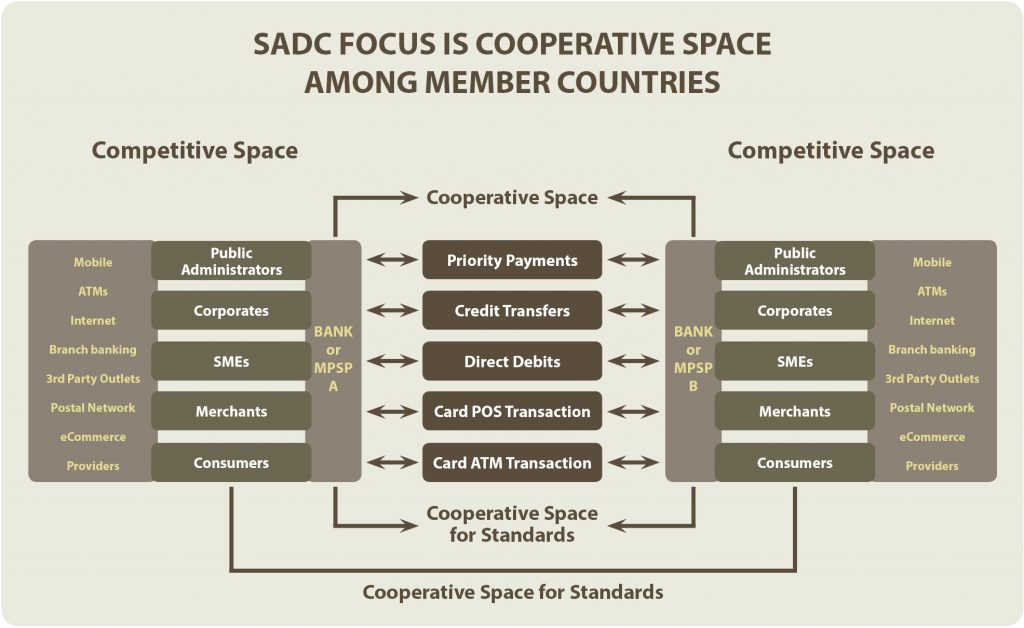
Diagram 5
The first activity undertaken with any SADC Payment Scheme has been the articulation of the operating model.
SADC BA ensured involvement from all SADC countries by the appointment of in-country payment leaders. Each country was responsible for the development of a payment stream while at the same time ensuring representation at other payment streams.
Each in-country leader was required to form in-country teams comprising the representatives at the regional forums.
Once the operating model is signed off by the relevant committees the final model gets incorporated into the SADC Beige Book and the message standards in SWIFT.com/MyStandards and made available to all central banks, commercial banks and other interested organizations.

Diagram 6
1.3.4 IMPLEMENTATION GUIDELINES
The World Bank guidelines make it clear that effective leadership is crucial to ensure all potential risks the project may face are adequately managed.
Transparency throughout project deployment (e.g. progress reports) also helps in ensuring continued buy-in and commitment from all relevant stakeholders.
The SADC CCBG Payments Committee and SADC BA set up the necessary implementation teams, reporting structures, communication functions when developing the payment schemes.
The diagrams below show the type of information discussed by the senior project teams dealing with the SADC payment scheme concerning low-value credit transfers cleared on an immediate basis (TCIB).
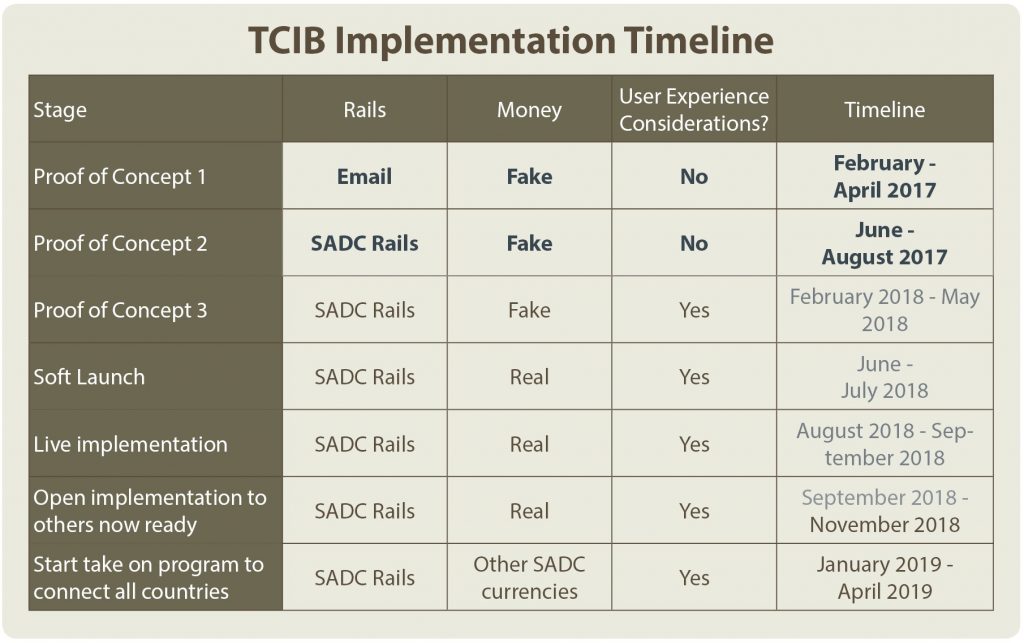
Diagram 7
Presentations are made throughout the project to the regulatory structures, i.e. PSOC and PSMB as well as to convenings of scheme participants and individual banking associations.
Extensive meeting notes are not made at each project meeting but rather key meeting outcomes (action items and dates) are documented.
The diagram below explains what had occurred in the development life cycle of the SADC TCIB project which was split into stages of proof of concept and then proof of capability etc.
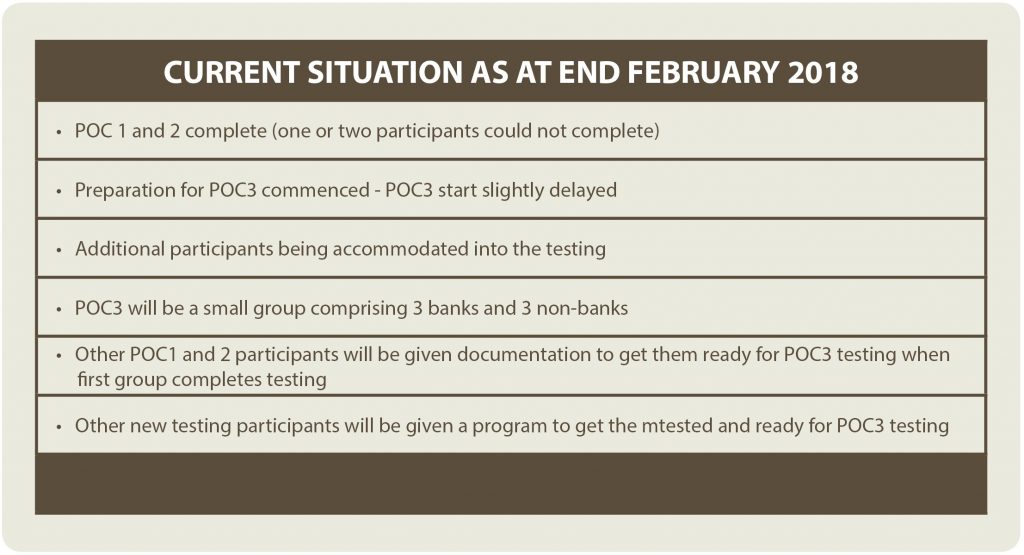
Diagram 8
1.3.5 SUSTAINABILITY GUIDELINES
The World Bank sustainability guidelines aim at establishing a strategic direction and a sound business culture for the regional FI arrangement that, together with the ongoing oversight from public sector authorities, will help ensure that the new regional FI will continue to evolve and develop to meet future stakeholder needs, satisfy any new legal and regulatory requirements affecting its operations and remain sustainable and relevant over the years.
SADC has institutionalised the on-going regulatory and oversight infrastructures to manage the on-going maintenance and enhancements to implemented infrastructures.
This consists of the central bank SADC Payments Oversight Committee and the Payments Scheme Management Body being the self- regulating body for a SADC payment scheme.

Diagram 9
Standing meetings between the public sector and the private sector have been set up to ensure that the SADC Payment Schemes stay relevant.
All intellectual property developed for the SADC payment project has been encased in the SADC Beige Book and associated documents linked to the Beige Book. All payment message standards are housed on SWIFT.com/MyStandards. All participants in the various SADC payment schemes have access to the book which is hosed at https://www.sadc-ba-beigebook.com.
The diagram below reflects the four areas of IP housing;
- The Beige Book – all operating models, rule books, etc.
- Message standards portal
- Associated documents such as SLA’s, agreements, technical specifications etc.
- Operator documents such as SLA’s, interface specifications etc.
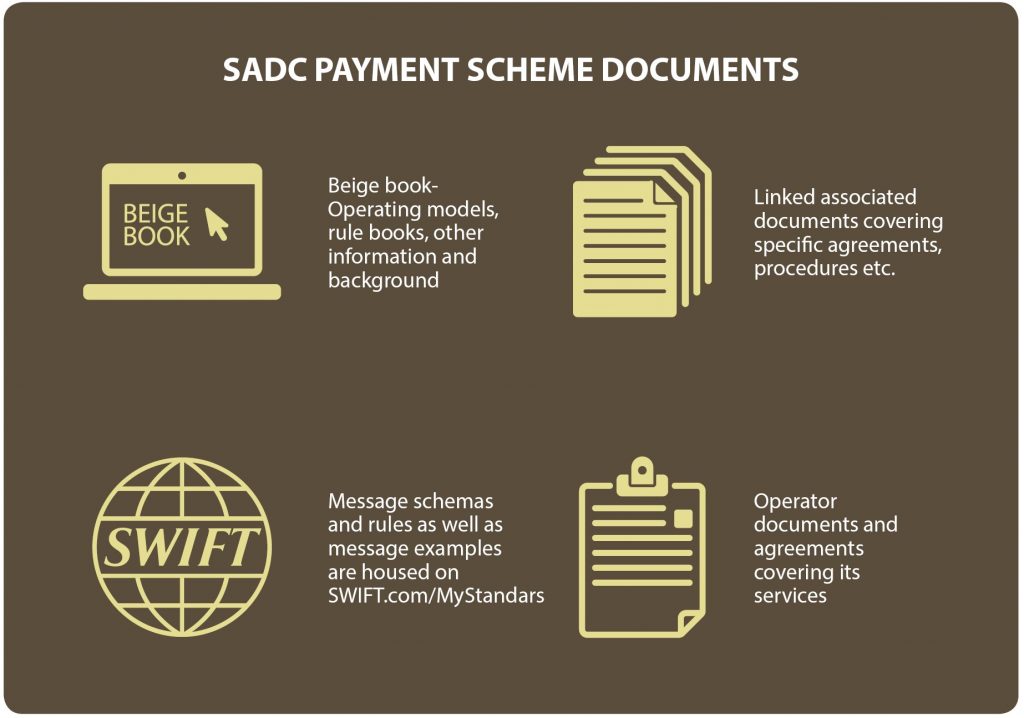
Diagram 10
Governance structures and processes are in place to manage updates and changes required to the SADC payment systems IP on an ongoing basis.